
Sheila Kidd is Professor of Gaelic Literature and History at the University of Glasgow and sits on the project’s advisory board. Sheila’s work to date has dealt with Gaelic literature from the 18th to the 20th century, with a particular focus on the press, and with the linguistic landscape of the 19th-century Highlands, providing a more nuanced picture of language contact and a deeper understanding of social relations and dynamics of power in the nineteenth-century Highlands.
The Gaelic text which has prompted this post is one which Juliette Desportes uncovered during her archival work in the National Records of Scotland (NRS) while researching illegal woodcutting in Strathspey. When she shared it with me back in the spring it was, without a doubt, the most interesting email that I’d had in ages (apologies to anyone that I’ve just offended!). This three-page document which begins with the words ‘Gearran Shémarlan Thighearna Ghrant ’nionsidh Bailli Barronach Srathspé’ (Petition of the Laird of Grant’s Chamberlain to the Baron Bailie of Strathspey) concerns damage to woods and is written entirely in Gaelic.
While I’m tempted to say that it’s a unique survival it quite possibly is not and the archives may hold other, as yet unidentified, estate papers written in Gaelic. At the very least it is a rare survival and a marvellous find which sheds light on communications between both the local justice system and estate officials and a Gaelic-speaking tenantry in the later eighteenth-century Highlands, and indeed raises questions about communications more widely between English and Gaelic speakers in this period.
The document is contained within Item 12 of 29 GD248/537/3 of the Seafield Papers, held in the National Records of Scotland. The catalogue description of Item 12 is ‘1770 Complaints made to baron bailie of Strathspey anent damage done to woods belonging to Sir Ludovick Grant of Grant. With undated document in gaelic. 6 pieces.’ So, the existence of this Gaelic document is not, in fact, unknown but, rather, overlooked and it’s exciting to have it drawn to our attention through Juliette’s work.
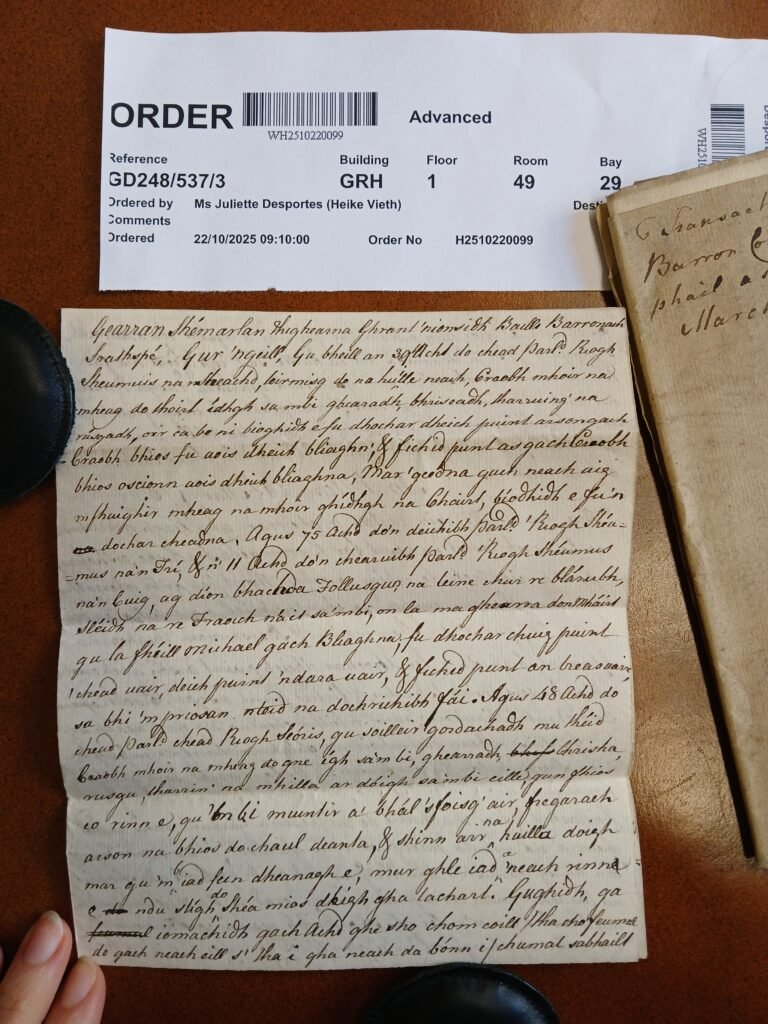
The document’s first page. NRS, GD248/537/3.
English was the language of estate administration in the eighteenth-century Highlands, at least in terms of the official record, even though the majority of tenants across the Highlands would have been Gaelic speakers, very many of them monoglot Gaelic speakers at the time this document was written, including in Strathspey. The Rev. Patrick Grant’s contribution on the parish of Duthil and Rothiemurchus to the New Statistical Account of Scotland (1792) states that ‘the language principally spoken is the Gaelic’. The way in which communications between estate officials and tenants operated on a daily basis would, however, by necessity have required the use of Gaelic in many instances and estate officials who did not speak Gaelic would have found it difficult to fulfil their obligations. A letter from 1748, refers to the Duke of Gordon’s factor for Badenoch resigning his post due to his lack of Gaelic (NRS GD248/173/2) with efforts to hire Gaelic-speaking factors for various Highland estates continuing through the nineteenth century.
Evidence is more readily obtained for the nineteenth century than the eighteenth with, for example, the occasional estate communication in Gaelic with tenants surviving in the press such as a notice published in the Inverness Journal on 2 October 1835, warning in both English and Gaelic against killing game on Earl of Seafield’s Urquhart Estate. The need for estate officials to be able to communicate in Gaelic was still evident at the end of the century. The evidence given before the Deer Forest Commission in Glenshiel in 1893 includes the estate factor, William Mackay, reminding Donald MacRae, a cottar from Kintail, that he had read a statement to crofters and then explained it to them in Gaelic. This is part of a wider picture of language use in the Highlands where interpreters were often drawn upon to assist communication between monoglot English speakers and monoglot Gaelic speakers (or those with limited English skills).
This eighteenth-century document is unusual as very few examples of written secular Gaelic prose of any sort survive from this period and so we have here an excellent, and highly legible, example of written eighteenth-century Gaelic from Strathspey which will benefit from further detailed study. It is interesting that one of the other rare examples of written Gaelic prose from this period came from the pen of a Badenoch native, James Macpherson of Ossian fame who, during his time as MP for Camelford in Cornwall, exchanged many letters with his fellow Gael John (later Sir John) Macpherson during his time working for the East India Company and later for the Bengal legislature. The men used Gaelic, sometimes a few words, sometimes many lines, within their English letters as means of concealing their political machinations from prying eyes. They also provide interesting evidence of Gaelic as spoken by the men, with James’ letters, for example, showing some clear instances of his Badenoch Gaelic.
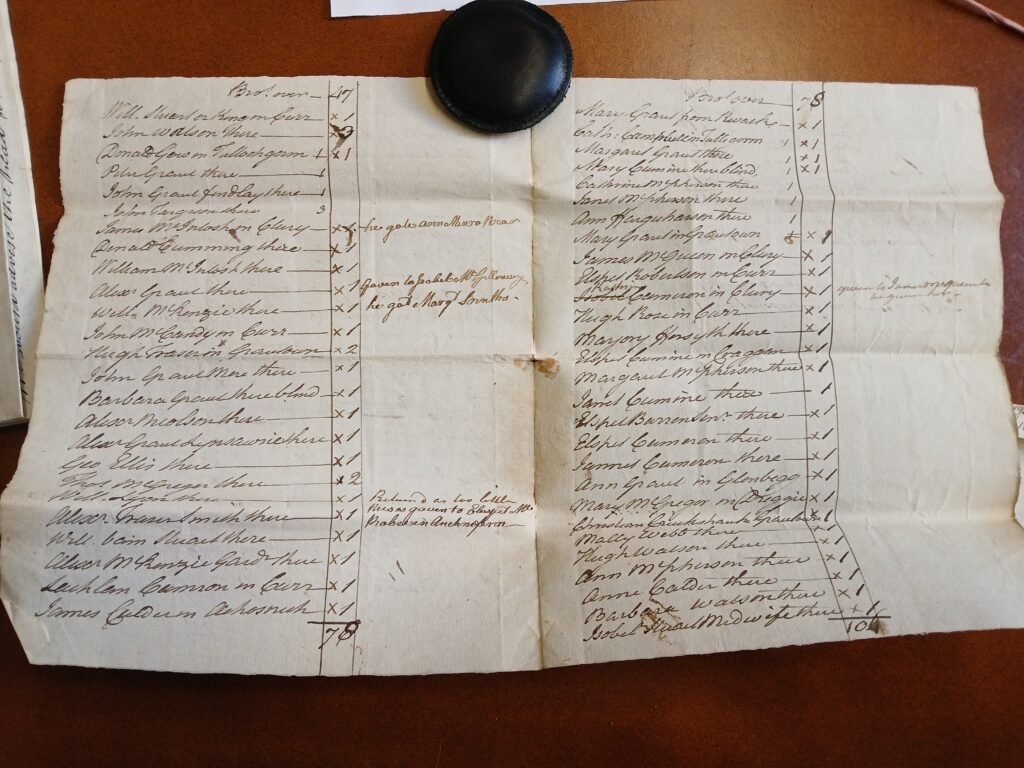
A list of tenants who received timber in Strathspey. NRS, GD248/537/3.
The Strathspey Gaelic document begins by outlining the various acts of parliament which forbid the damaging or removal of trees, a valuable estate resource, and the penalties associated with these various crimes and is a loose translation of another document preserved alongside it, a petition from Sir Ludovick Grant’s factor, John Grant, to Robert Grant, the Baron Bailie. The second part of the document which, contrary to the catalogue entry, is dated 28 May 1763, is a translation of one of the other English documents catalogued with it. This English document was issued by the Baron Court of Strathspey and proclaimed the various crimes relating to the ‘peeling, culling, destroying, stealing or defacing’ of trees on the estate of Sir Ludovick Grant and his son James Grant, and the penalties which those convicted of these crimes could expect to receive. The fines associated with muirburn (‘follusgar’ in the Gaelic version, modern Gaelic falaisgear) carried out between the end of March and Michaelmas (29 September) were also outlined. It concludes by stating that, in order that none may claim ignorance of these:
a full Copy of Extract of these presents to be made out by the Clerk of Court, & publicly read from the lectern by the Reader or Precentor in each Parish Church within said Barony on Sunday next the Twenty Ninth day of May in English, & on Sunday thereafter in the Erse or Galick Language and to continue to be read in like manner alternately the first and second Sundays of each quarter for the year following.
This last part, therefore, clarifies the purpose of the Gaelic document which must have been created specifically for being reading aloud to congregations within the barony of Strathspey. Furthermore, we must assume that it was produced by the clerk to the baron court of Strathspey, a Gaelic speaker who was also able to write the language. Created not as an official document but as a text which was presumably copied and shared with the local clergy, it is a somewhat ephemeral document by its nature, making its survival all the more remarkable. It is a wonderful find which adds to our understanding of how the interface between Gaels and English-speakers worked at a practical level. And it provides Gaelic scholars with a document which will repay detailed examination of the translation process and, of particular value, provides evidence for the dialect spoken in Strathspey in the second half of the eighteenth century.
Leave a Reply