
It has been a busy few months for the ‘Landscapes of Protest’ project team. Since officially launching the project back in Ullapool back in March, Juliette Desportes (RA) has completed two trips to the National Records and National Library in Edinburgh this Spring which produced some promising material.
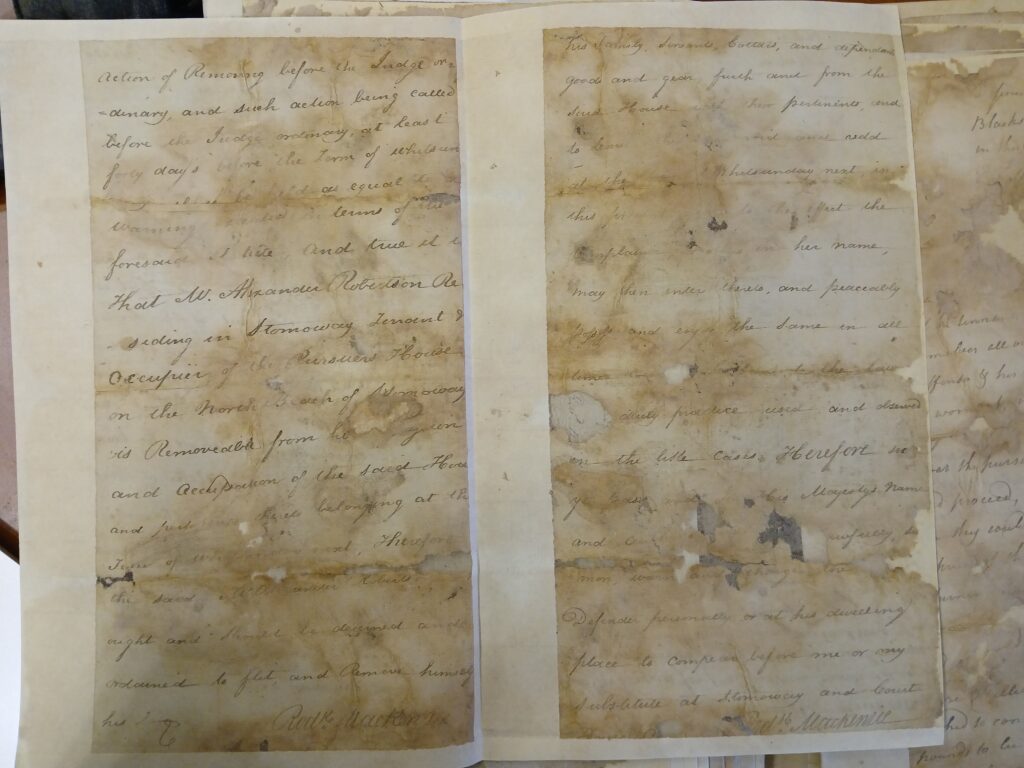
These early archival visits focused on two of the project’s five case studies: Argyll and Kintyre; and the Isle of Lewis. As well as estate records, Juliette consulted evidence from the lower law courts, namely the sheriff courts of Inveraray and Stornoway. The objective was to survey criminal and civil processes for dates ranging from 1750 to 1820 and begin to identify patterns of transgression as well as prosecution in cases such as trespass, wood theft, and eviction.
Sheriff court records are fruitful, fascinating, as well as incredibly time consuming. Locating evidence quite literally felt like finding ‘a needle in a haystack’! The Inveraray criminal processes alone represent about a dozen of huge boxes for the period of study, meaning some sampling of the material was required. The first and immediate takeaway was the very high number of processes caused by wood taking and wood cutting by tenants. Wood theft, whether motivated by subsistence needs or by the search for profit, was widespread in spite of prosecution, an important reminder that law’s enforcement was not always followed by results.

Other types of actions appearing in Argyll as in Lewis involved cases of trespass and the use of animals – usually cattle – in protest events. In the Isle of Lewis, the privatisation of common grazings was often met with deep-seated hostility and, occasionally, spirited opposition. At the close of the century, estate management was concerned with the re-organisation of holdings, leading to mass evictions in the 1790s. These removals have left their mark in the archives which contains many summonses of removal. The island, then, appeared as prone to dissent in the 1780s as it did during the land wars of the 1880s.
All three members of the team will be travelling to Inveraray in late September, where visits to Inveraray Castle as well as the Argyll and Bute council archives promise to offer similar riches! Fresh from his recent survey of Luddism in England, Scotland, and Wales from the 1670s to the 1840s, Carl is excited to follow-up a potential case of anti-technology sentiment in Campbeltown. We’ll see what the archive contains. Juliette will then return to Edinburgh to visit the NRS and NLS for four weeks in October.
We are also excited to announce that both Iain Robertson (PI) and Juliette will be introducing the project and talk about the long history of protest in the Highlands and Islands at the upcoming Scottish History Local Forum conference in October. The conference will take place in Paisley on Saturday 25 October and tickets are available here. Alongside Iain and Juliette, the audience will be able to hear from a range of other wonderful speakers including Chris Whatley who has done so much to deepen our understanding of Scottish protest.

Leave a Reply