
This blog was written by Alison Diamond, the archivist for Argyll Estates Archives, the family and estate archive of the Campbell family, earls and dukes of Argyll, and a key member of the project’s advisory committee. We are immensely grateful to Alison for her expert input.
During their first visit to Inveraray Castle in September 2025, the ‘Highland Resistance’ project team identified many potentially relevant documents. One is a letter dated 2 July 1768 and addressed to Alexander Campbell, then chamberlain of Kintyre, described in National Register of Archives for Scotland survey 1209 (NRAS 1209) as ‘concerning luddite encroachments’ on Campbeltown Harbour. The suggestion of ‘luddite’ activity naturally flagged this document as one that might be relevant to a study of Highland resistance.
The description is taken from a docquet on the reverse of the letter. Docquets are frequently added to the outside of a folded document by the person ‘filing’ it to highlight or index its content and this is usually done contemporaneously. On this occasion, however, this seems unlikely as the adjective ‘luddite’ emerged in the early nineteenth century, some years after the actions or events of 1768 described in the letter.
The letter itself is written on paper which has been folded for some time and was originally sealed shut. The paper is dirty, is torn where the seals have been broken and the outer most folds have weakened the paper, resulting in tears and missing text. The document is written in a forward slanting hand, typical of the late eighteenth century, but it is also a particularly untidy hand: words sometimes run into each other and at other times are split oddly; individual letters are carelessly formed; there is very little punctuation and miscellaneous upper-case letters (which may or may not be meaningful!).
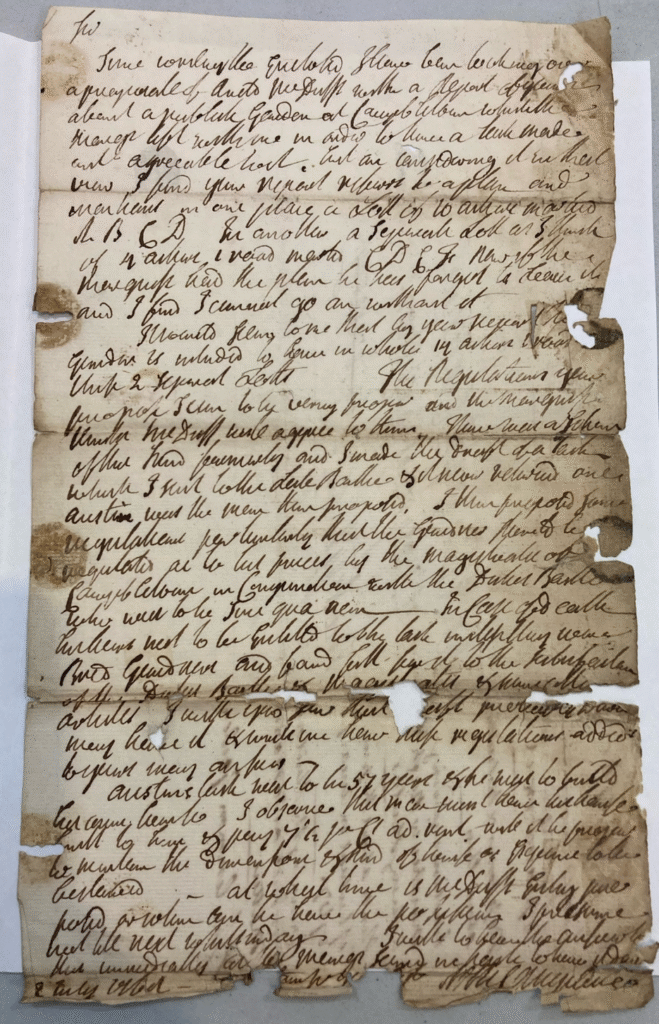
Letter by Archibald Campbell with ‘luddite encroachment’ docquet, 1768. Argyll Estates Archives NRAS 1209/528. Reproduced by kind permission of his Grace, the Duke of Argyll.
Re-reading the document several times and developing some familiarity with the hand resulted in a draft and very incomplete transcript. This was shared with volunteers from a regular online palaeography group. These groups usually focus on reading Scottish secretary hand, but the same process of identification is required for recognising letter forms from any period so it’s all good practise! One of the main problems of transcribing a document is that, once your eyes have seen a particular word, it’s very difficult to see an alternative; with the ‘hive mind’ approach of a group, someone else is bound to see it differently. Sharing the transcript helped to fill in gaps and suggest corrections, producing a transcript that is perhaps 80% complete.
But the transcript that we created makes no mention of encroachments, luddite or otherwise, on Campbeltown harbour: the letter is about establishing a market garden in Campbeltown and employing Archibald MacDuff to manage it.
MacDuff was gardener to the Marquess of Lorne, the eldest son of the Duke of Argyll, at Rosneath House. In 1769, the tack mentioned in this letter was put into effect and MacDuff was granted a tack of 4 acres of land at Whitehill on the outskirts of Campbeltown for a kitchen garden, providing he built a new house for the gardener (NRAS 1209/1960c/15). The kitchen garden was not financially successful: MacDuff appears in an account of summons and precepts of poinding for arrears of rent in 1771 (NRAS 1209/519/1); instructions to the chamberlain of Kintyre in 1776 advise that MacDuff is to be informed that he will lose his home if his rent is not paid (NRAS 1209/1954/19); and in 1792, MacDuff is petitioning the Duke for assistance due to the arrears built up while he possessed Whitehill (NRAS 1209/1946).
So, back to bundle 528 for an explanation of the ‘luddite encroachment’ docquet. The bundle is described as ‘papers relating to claims for compensation for damage done by the cutting of the coal canal through farms and moss-rooms in the vicinity of Campbeltown’. The documents date from 1768 to 1805, with quite a few undated and an eighteenth-century copy of a 1674 document. Within the same bundle there are two more documents dated 1768; one also written by Archibald Campbell and dated 2 July 1768 and the other a copy legal opinion in a much clearer hand.
Archibald Campbell’s second letter covers a variety of business including plans for rebuilding Campbeltown manse, straightening marches, calculating tenants’ arrears, but also mentions ‘Campbletown Loch Harbour & Moss rooms, [I] send you here enclosed Certified Copies with a letter to Provost Buchannan which I leave open for your peruseall, which contains every thing that is at present necessary on these subjects You had better press the magistrates to talk immediately to Saddell … so as to prevent, at lest for the present, further Improvements of that harbour and you may give them any assistance they may desire’.
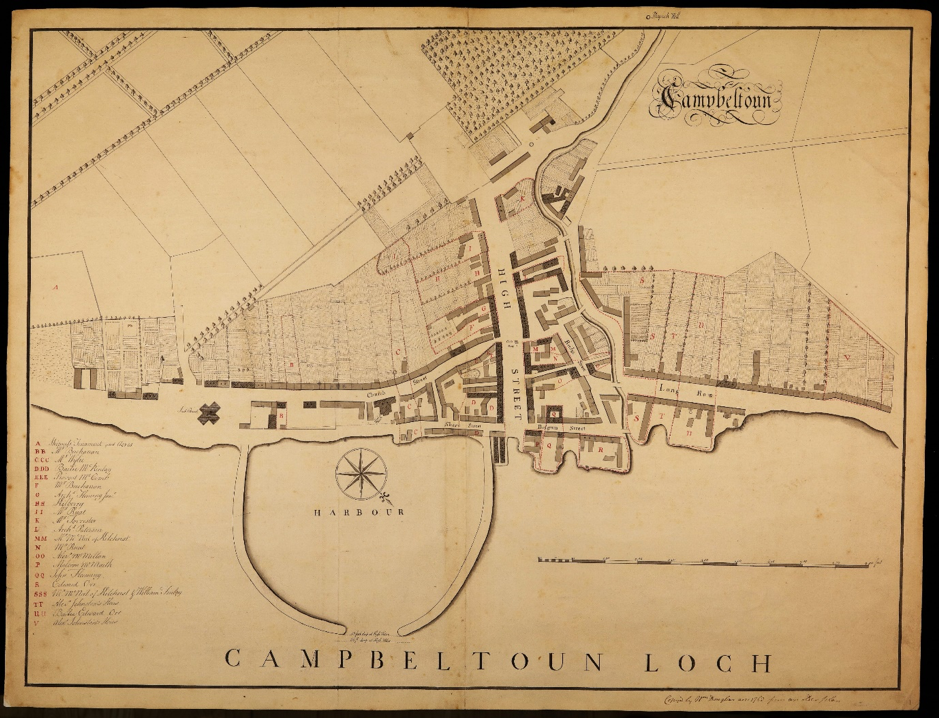
A plan of Campbeltown and Campbeltown harbour by William Douglas, c.1763 Argyll Estates Archives ARG/12/01/247
The other 1768 document is a certified copy of ‘Answers to the Duke of Argyll’s Memoriall & Queries concerning the buildings and quay made by Mr Campbell of Saddell upon the Loch of Campbeltown’. The development of the harbour at Campbeltown had begun in the early eighteenth century, initiated by the Dowager Duchess of Argyll and eventually taken on board by the Town Council. The laird of Saddell owned the lands which bordered the Burgh of Campbeltown to the north, and, in 1766, Saddell offered feus in his new town of Dalintober to anyone prepared to sponsor the building and maintenance of a new pier in return for the liberty to land or ship goods without making payment to the superior. Naturally, neither the Duke nor the Town Council were happy with this initiative, believing that it infringed on their Burgh rights. The Answers explain the legal position as understood by the Duke’s Edinburgh lawyers; that the Burgh charter ‘is very darkly and inacurately expresit. By the first part of it it would seem that the free sea port thereby granted meant to comprehend the whole loch, whereas the after words seem to imply a priviledge of erecting one or more ports in any other part or parts within the bounds of the S[ai]d loch’. The Town Council ordered Saddell to desist from any further encroachments on the loch but the matter was not finally settled until 1844.
A closer look at the original documents suggests that these three papers may have been wrapped together, with the initial docqueted letter the wrapper on the outside of the bundle. This would explain the apparently erroneous docquet on the letter about MacDuff. Moreover, if the issue of Saddell and his Dalintober pier was not finally settled until 1844, then the documents may have been filed and the docquet written in the 1830s or 1840s, when the adjective ‘Luddite’ had come into use.
Whether or not the encroachments on the harbour should be described as ‘luddite’ I will leave to the historians.
My thanks are due to Bob Reid and Margaret McBryde for their assistance with the palaeographic challenge and to Carl Griffin for drawing my attention to the document in the first place.
Leave a Reply