
In the early 1800s, the farm of Northton (Taobh Tuath), Isle of Harris, was the scene of a violent confrontation between the recently introduced farmer and his crofter neighbours in nearby Scarista (Sgarasta). The case, as we shall see, was typical of the growing tensions brought about by the rise of privatisation and ‘improved’ agrarian practices. While less spectacular than the better-known land raids erupting some decades later, early findings from our project suggest that acts of protest such as these were quotidian across the Highlands and Islands and constitute one of many little-known stories of daily struggle for the land.
William MacGillivray, the grandfather of the eponymous naturalist, had been granted the tack of Northton in the opening years of the nineteenth century. A retired army surgeon, MacGillivray was not a native of Harris and probably hailed from Stratherrick in the central Highlands. His wife Euphemia (or Effie) was however from the nearby isle of Pabbay. MacGillivray was the first principal tenant of what had recently become the farm of Northton. One hundred years previously, the area had been divided into four different townships comprising of at least nine different families. The townships had then been added to different tacks at various points but by 1800 formed one large farm as portrayed on Bald’s 1805 map of the island.
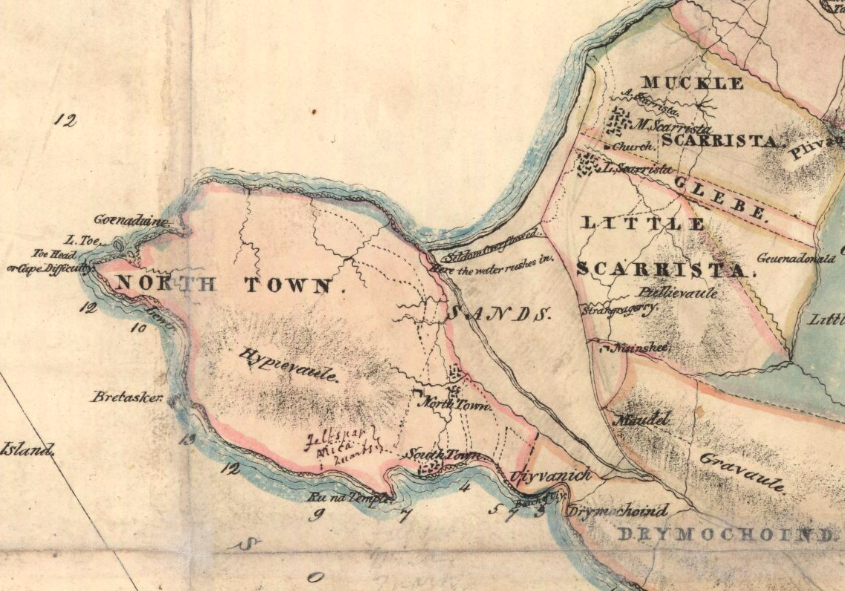
“North Town”, on William Bald’s Map of Harris, 1805. Courtesy of the National Library of Scotland.
This process of land consolidation was typical of the period of ‘improvement’, whereby smaller townships (and their grazings) were merged into one larger and, therefore, more lucrative, farm. This rapid and dramatic change in how land was farmed and occupied led to an increase in accusations of trespass or encroachments, usually brought by a landlord or tenant wishing to enforce its rights of use of a particular space. As customary practices became superseded by an increasingly commercialised world, so was access to ‘old ways’ frequently travelled by local inhabitants curtailed by the construction of dykes or other forms of enclosures. Cases of trespass and encroachments upon farms and commons feature heavily in civil and – less frequently – criminal processes of Scottish sheriff courts. One of such cases was brought by William MacGillivray at the Inverness sheriff court in 1807.
MacGillivray presented his complaint in the shape of a petition, where he reported he had under his control as much as 2,000 acres of arable and pasture ground, making his possession a large one. In spite of his efforts to preserve his winter grass for his cattle, however, he admitted being frequently importuned by ‘a set of lawless people who consider themselves at such a distance from the seat of justice that the strong arm of the law cannot reach them’. The ‘lawless’ tenants MacGillivray referred to were no others than the joint tenants of nearby Scarista who persisted on trespassing upon Northton’s extensive pasture grounds and, as MacGillivray put it, ‘trampling under foot the grass intended for the support of his cattle’.
Contrary to Northton, Scarista had not yet been turned into one large farm. By 1807, Scarista still consisted of two townships including dozens of families each. The situation of the two farms, only separated by salt marshes and extensive sand beach, explains easily why cutting through Northton’s pasture ground would have offered an attractive and easy route for Scarista tenants. MacGillivray’s complaint makes clear that this sort of trespass was a regular occurrence.
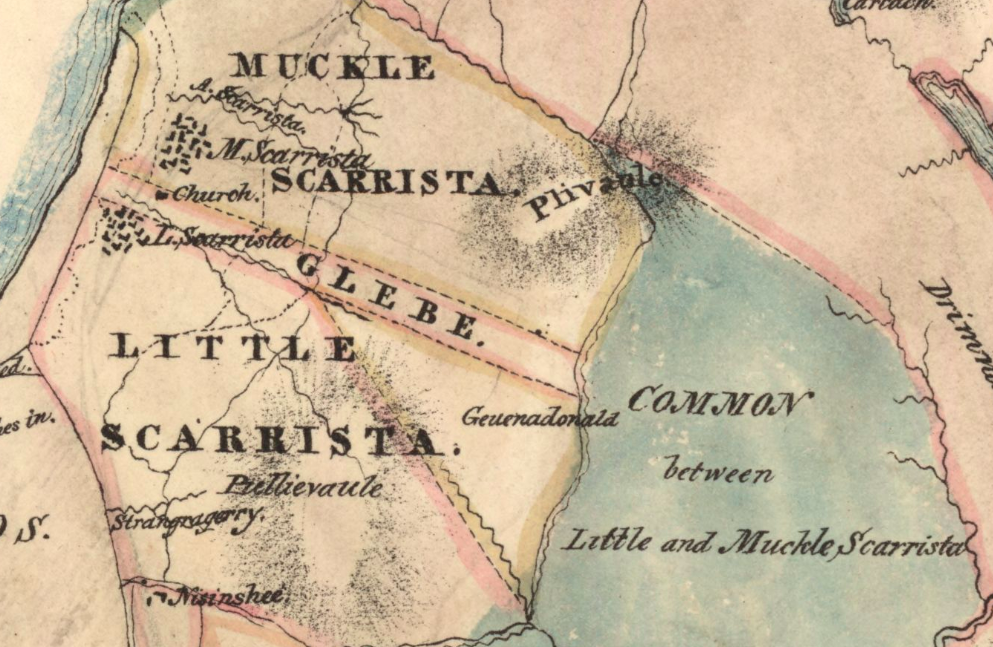
Scarista townships on William Bald’s Map of Harris, 1805. Courtesy of the National Library of Scotland.
Another of MacGillivray’s complaints regarded the fishing or rather what he described as poaching the ‘Cuddies (coalfish) in the Bays with which his farm is intended’. Like trespass, poaching was not an uncommon accusation in the sheriff courts, although many landlords tended to turn a blind eye as long as tenants did not target salmon or deer. MacGillivray, however, did nothing of the sort. He recounted an incident which had allegedly taken place on Sunday 20 September during which a ‘numerous gang of neighbours’ had entered his parks and fished openly in the bay. A confrontation had then taken place after the men refused to stop and ‘told him that they would go through his parks and inclosures and trample him under their feet’. One man named Alexander Morrison then threatened MacGillivray of shooting him ‘thro’ the head of he said another word or attempted to impede them’.
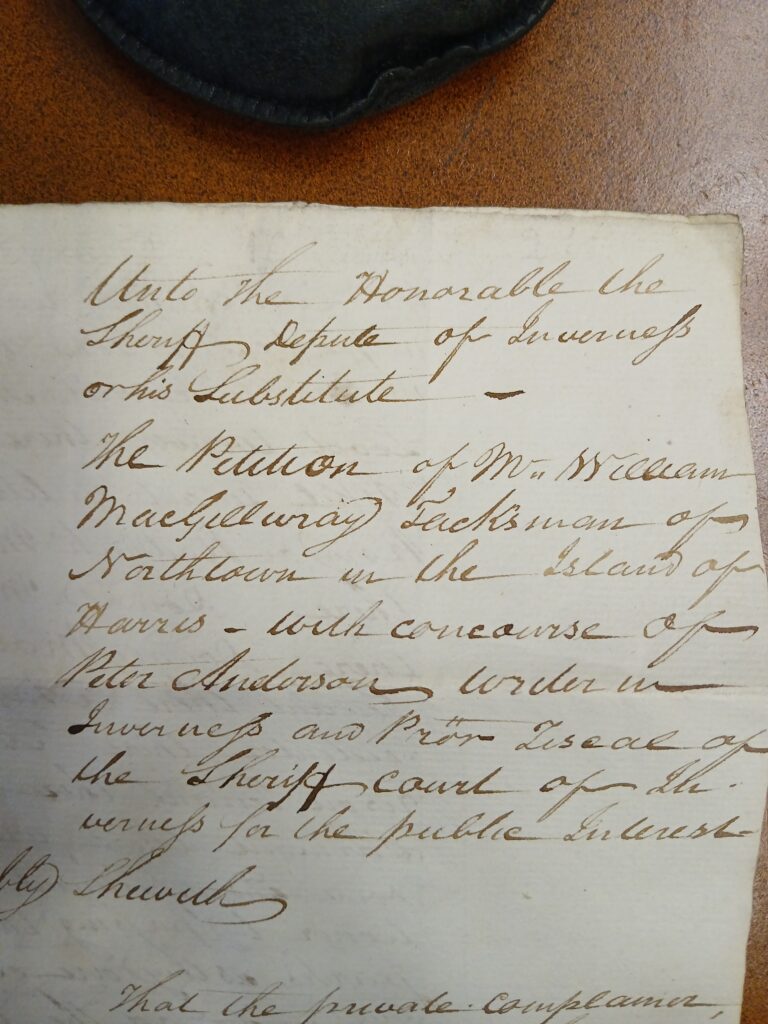
William’s petition to the sheriff court of Inverness, 1807. Courtesy of the National Records of Scotland.
If taken at face value, the boldness of the language of the Scarista tenants suggest they were merely enacting practices they had been in use of enjoying for a long time. The incident reveals the sort of mounting tensions over privatisation that resulted in the assertion of rights – in this instance both of access and use of the land as formerly. MacGillivray’s suggestion that the confrontation took place on the sabbath is particularly noteworthy and may well had been a lie to make his complaint appear more dramatic and outrageous. The farmer demanded the high sum of £100 sterling in damages, but neither the accused’s defences nor the court’s final judgement have survived.
Only a few years later in 1817, William’s eponymous grandson, the famous naturalist, travelled back to Northton to stay with his uncle Roderick who had taken over the farm. By then, Harris’ infamous factor Donald Stewart had started to convert the west side of the island into sheep walks and had set his sights on Northton. MacGillivray wrote in his diary that he had confronted Stewart and accused him of self aggrandizement, an open criticism of the mass clearances which would sweep the region.
And yet, MacGillivray failed to observe the irony: his family had, not that long ago, been the caused of a drastic landscape change and their presence the object of protest. Nonetheless, the naturalist had been right: in 1826, Scarista was cleared and Northon eventually became a sheep farm. Digging through the little used records of local courts presents an alternate side to this well-known tale and confirms that neither crofters nor tenants went along passively with what they perceived as an illegitimate infringement upon their rights.
Further reading
Bill Lawson, Croft History, Isle of Harris, Volume 6 (Comann Eachdraidh na Hearadh, 2015)
William MacGillivray, A Hebridean Naturalist’s journal, 1817-8, ed. Robert Ralph (Acair, 1996)


Leave a Reply