
Professor Carl Griffin is Visiting Professor at UHI and Professor of Historical Geography at the University of Sussex. Carl is also a lead on the ‘Resistance to improvement’ project.
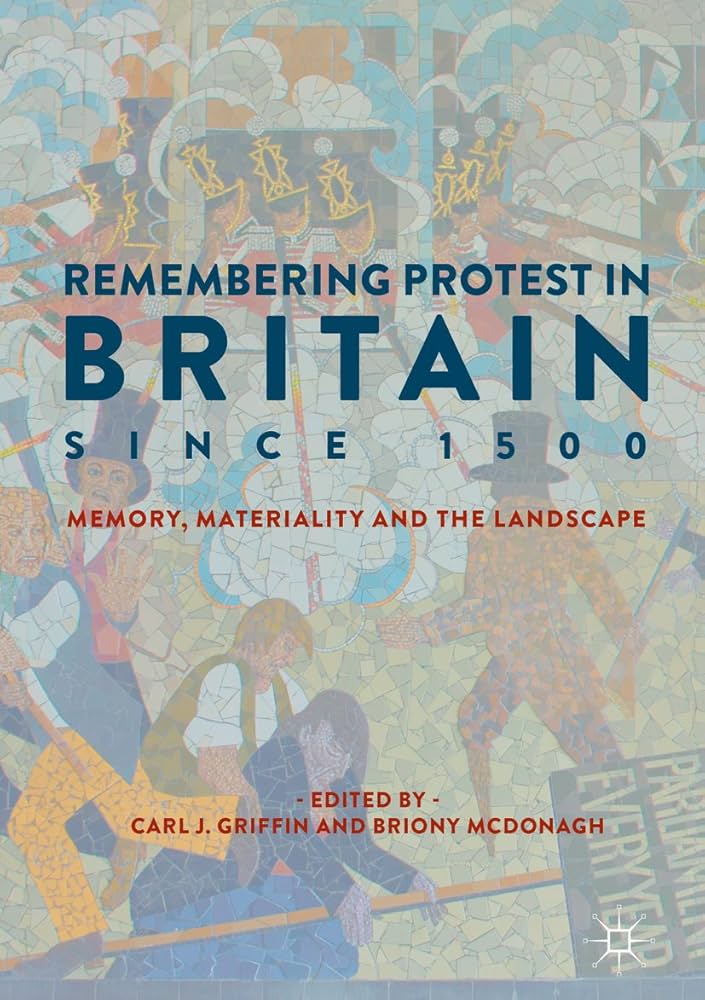
I am not a historian of Scotland. Nor am I a Scottish historian. I have no family connections to Alba. I was born in Kent, not Kildonan. But, on a clear day, I can see the Rhins of Galloway from my attic window, and on a spectacular day Merrick in the Galloway Hills is also visible. From my first excursion to Glasgow, then Edinburgh, Ayr, Arran, and Skye, I have always enjoyed being a sojourner in Hibernia visits. It is the same for my reading of Scottish history. An early exposure as a doctoral student at Bristol to the works of Smout, Richards, Devine, Withers et al piqued my interest, but not enough to part me from labours with Captain Swing. None of this qualifies me to be part of a project examining anything to do with Scottish history. And yet… Since Christmas 2019, I have been a visiting professor at the University of the Highlands and Islands’ Centre for History in Dornoch, my occasional visits – made even more occasional thanks to the impacts of Covid-19 –cementing of my long-term collaboration with Iain Robertson. A series of seminar papers, guest classes, and research workshops later, my laser-like focus on the protests and politics of rural England since the Restoration began to be tested. A review of a book on protest memory in Britain that I edited with Briony McDonagh which noted the lack of content on Scotland – this not being the original plan, but one author had to withdraw – also forced me to think more about Scottish resistance. How did the English experience compare to that not just of Wales and Ireland, but also of Scotland? The rise of global history has also usefully forced us all to think more about connection, interdependence, circuits of capital as well as rule and misrule. To think only of rural England was to imagine a world that never existed.
Slowly sucked into Iain’s intellectual world, equal parts in awe and frustrated with the historiography on Scottish protest and wowed by the riches of the archive – here I blame those foresighted individuals who made the Napier Commission available online – working on Scotland became inevitable. It started with thinking through a paper on protest ‘afterlives’, the idea that we need to think not just about the moment of protest – this the obsession of protest historians – but how, like the aftershocks of an earthquake, that moment lives on. Conceived as a conceptual piece, the afterlife of a land raid on Eoliogarry Farm, Barra, became not just the hook on which our ideas hung but the central story. I cannot, however, take great credit for the empirics of this, that was all Iain’s doing, my role being co-writing the conceptual and historiographical parts and helping to frame the analysis of Iain’s archive. It is, however, a long way from a solitary paper to being part of a three-year project examining the resort to resistance after Culloden in the Highlands and Islands.
What, you might reasonably ask, does this novitiate bring to this rarefied game? Beyond the judgement of the Leverhulme Trust and their assessors, arguably such an assessment is up to you – our audience, the readership – to decide. But here is my case. Having in some small way helped to revive and reconceptualise the study of modern-era popular protest in an English context, I’m able to bring new ways of thinking and new ways of reading the archive to the study of Highland resistance. Indeed, in some ways, coming from outside the Scottish historical establishment and having a background in English rural history is a decided advantage: I can ask bold, and perhaps occasionally naïve, questions of the historiography and archive. None of this is to say that having a knowledge of English protest allows me to simply bluster into the archive and straightaway offer in-depth, nuanced analysis, but it does give a new, critical perspective. Already this is paying dividends in locating a range of protest practices in the archive that have hitherto been ignored (or at best marginalised) in Highland history. This perspective also allows us to ask comparative questions: given our expertise, is there such a thing as a peculiarly Highland form of resistance? Or are there striking parallels with what happened elsewhere?
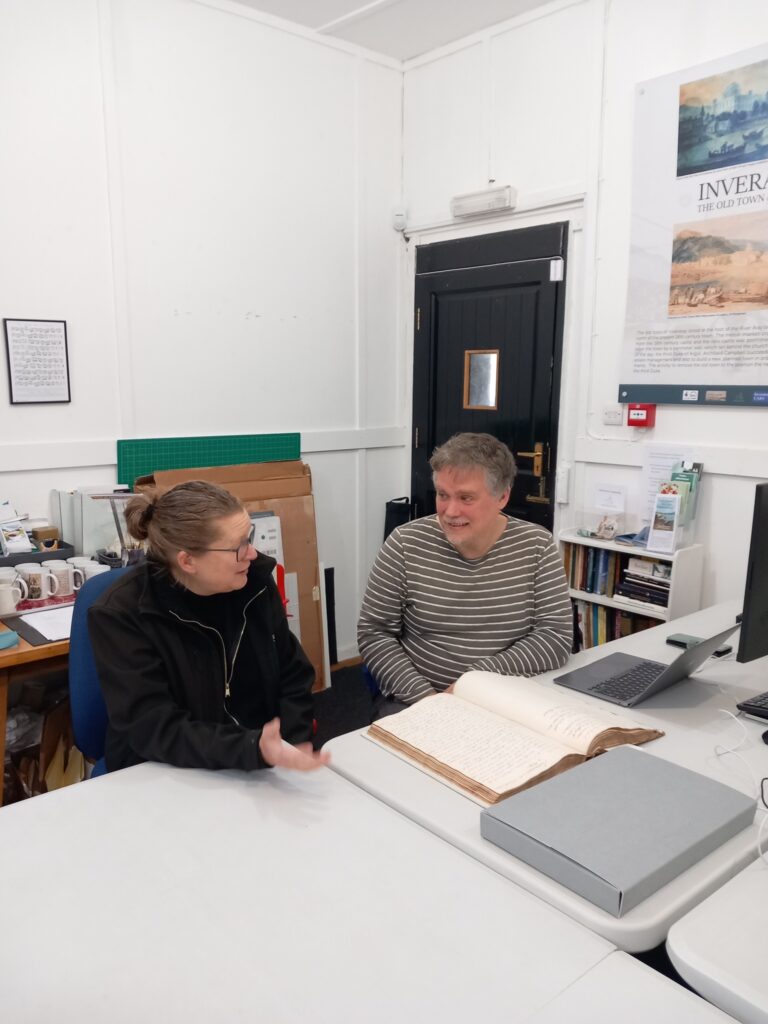
Carl and Alison Diamond, Inveraray archivist, at the archives in Inveraray earlier this year
And then there is the issue of land. England has not (yet) had the land rights consciousness revolution that, in waves, has taken hold in Scotland. A consequence of this is that land, as a subject and category of historical analysis, has a limited hold in the English academy, though the comparative sets of essays edited by Matthew Cragoe and Paul Readman (2010) and by Shaun Evans, Tony McCarthy and Annie Tindley (2022) are vital exceptions. Of course, enclosure – and its opposition – has long been a mainstay of English rural history, but this is rarely worked through into the future to ask why land ownership remains so unequal in England (if nowhere near as unequal as in Scotland). And, in turn, this relative lack of critical curiosity about land ownership in England – though the inspiring campaigning of Guy Shrubsole and Nick Hayes is gaining traction – informs the relative paucity of work on land politics. By way of comparison, and I feel this is no exaggeration, land dominates work on (modern) rural Scotland. What is a by-line in southern Britain is the headline in Scotland. It is the obsession, understandably so, that informs all. But – and, again, my relative intellectual freedom is important here – I am allowed to at least ask the question ‘but what else’? The militia riots of 1797 and, in many ways though the connection is obvious, the occasional resort to ‘meal’ riots have received some focus in the wonderful work of Chris Whatley, Eric Richards, and Jim Hunter, but what of the importance of workplace conflict? After all, not all residents of the Highlands and Islands were tenants, many were, for instance, landless labourers. What of the role of the Church, and, relatedly, what of the poor law authorities as generators of social conflict which spilt over into acts of protest? How did the rise of political radicalism – Jacobinism as opposed to Jacobitism – inform and inflect social relations outside of the major cities and the Central Belt? This is not to deny the primacy of land, or the brilliance of so much of the painstaking work of scholars such as Ewen Cameron and Annie Tindley, but it is to open the debate.
So, what is in it for me? I remain absolutely committed to my deep-seated study of rural England. Amongst other writing projects, I am deeply immersed in writing a monograph on the importance of encroachment and squatting on English commons and other ‘wastes’ as a form of overlooked enclosure in the modern era, and often enacted by the poor. Working on – thinking about – the Highlands and Islands provides a welcome contrast as well as a point of comparison. New debates, historiography, new (to me) archives, and new challenges all force me to think and work in different ways. To be so challenged is hugely rewarding and liberating. And to work with such talented historians as Iain and Juliette is as much inspiring as it is fun. We have achieved a great deal so far. Two papers are drafted – one submitted, one about to be submitted; papers have been presented; many archives visited. My highlight so far? Visiting the wonderful Argyll archive at Inveraray Castle, this in no small part due to the generosity and expertise of archivist Alison Diamond and so wonderful estate papers.
Leave a Reply